
Published November 13, 2026
Why Data Centers Matter: Kentucky’s Role in the Future of AI, Jobs & Economic Growth

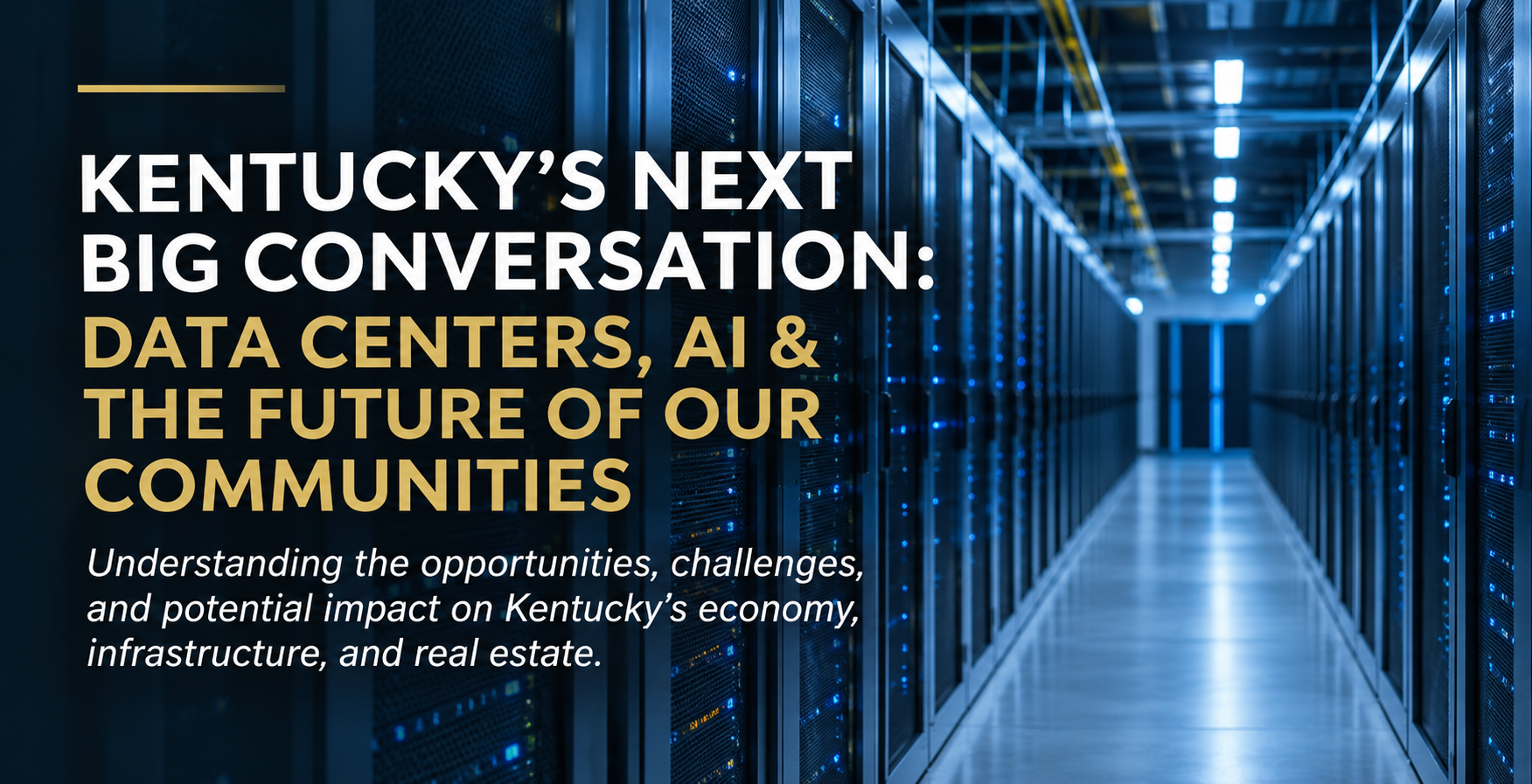
Why We Need Data Centers—and Why Kentucky Is in the National Spotlight
By Melia Hord | MELIA Realty
Where do your iCloud photos live? What makes it possible to stream Netflix, check Facebook, pay a bill online, or open your banking app?
We call it “the cloud,” but our information depends on physical equipment somewhere. Data centers house the computers that store, process, and deliver the information behind many of the services we use every day.
Our phones make those connections feel effortless. Behind the screen is infrastructure that requires buildings, electricity, communications networks, security, and people to keep it working.
That is where the conversation about data centers needs to begin—with understanding why we need them.
At the Commerce Lexington Economic Summit on 11/12/26, speakers from banking, higher education, development, telecommunications, and the energy industry explained how this infrastructure supports our lives. Joe Craft also made a broader case: he sees artificial intelligence and the infrastructure supporting it as an economic and national security opportunity Kentucky should prepare to participate in.
As a real estate advisor and business owner, I believe this conversation deserves our attention. It connects directly to employment, infrastructure, housing, and the future of our communities.
We already depend on data centers
Think about how much of your day involves information moving electronically: photographs saved in iCloud, paperless billing, online purchases, business records, medical information, and messages to family and friends.
During the summit, banking representatives described computing infrastructure as essential to protecting customer information and detecting fraud. Telecommunications representatives discussed its role in connecting businesses, households, and emergency services.
The University of Kentucky representative explained how computing supports education, research, and advanced medicine. He described constraints in UK’s local computing capacity and its reliance on facilities outside Kentucky.
These services are already part of our lives. Understanding the infrastructure behind them helps us ask better questions about what comes next.
AI is creating additional demand and possibilities
One university example especially caught my attention.
Academic advisors may work with hundreds of students. Before an appointment, they need to review previous conversations, academic interests, and goals. UK described an AI tool that helps advisors prepare more quickly, leaving more time for a meaningful conversation with the student.
In healthcare, the representative described using AI to help clinicians work with information while keeping professional judgment central.
Those examples show why organizations are investing in computing capacity. They are exploring ways to improve their work, serve people more effectively, and make better use of limited time.
Supporting those applications requires infrastructure, along with careful attention to privacy, security, and responsible use.
Why Joe Craft connected AI to national security
One of Craft’s strongest points was that he views the competition to develop AI as a national security issue, particularly in relation to China.
His argument was that the United States needs the ability to develop and use this technology—and that doing so requires investment in computing infrastructure and dependable energy.
He described the competition as ongoing, rather than a race with a clear finish line. In his view, the country must continue building its capabilities.
That adds another dimension to the local conversation. Decisions about infrastructure can influence our ability to support technologies that businesses, researchers, and public institutions increasingly use.
Craft’s message to Kentucky was to recognize the opportunity and prepare for it.
Kentucky is in the national spotlight
This conversation is already taking shape across our state.
In Paducah, the U.S. Department of Energy has announced a partnership to redevelop portions of its site for a data center campus and new energy infrastructure. In Mason County, officials have approved agreements advancing a proposed Meta campus. These are significant development steps, although announcements and approvals are different from operating facilities.
In Eastern Kentucky, TeraWulf has announced expanded power agreements for its Muskie Data Campus, with the expansion subject to regulatory approval and infrastructure schedules. Kentucky’s energy planning commission has also identified projects under consideration in Hardin County—the Elizabethtown area—and other counties.
And this infrastructure is already part of downtown Lexington, including an established telecommunications and data center facility long associated with Windstream. These operations have been serving communities for years, often without attracting much public attention.
The opportunity extends across our state line. West Virginia is actively pursuing major data center investment and has announced a statewide framework for development. Kentucky is competing with places making deliberate decisions about how to accommodate this growth.
When a community closes the door, a company can choose another location. For projects of this scale, that can mean redirecting billions of dollars in potential private investment, along with construction work, supplier opportunities, and negotiated community benefits. Private investment and public tax revenue are different measures, but both deserve consideration.
The opportunity reaches beyond the buildings
Craft encouraged leaders to consider the larger network of work surrounding data centers and energy development.
Panelists discussed construction, skilled trades, equipment, components, maintenance, and supporting services. They also pointed to businesses that could use AI to improve productivity and expand their capabilities.
Craft spoke particularly about rural Kentucky and creating careers that allow people to stay in—or return to—their home communities.
That requires preparation. Employers, contractors, educators, and workforce organizations need to understand which skills will be needed and when. Training should expand opportunity while recognizing the staffing needs of businesses already here.
As someone who helps families build a life in Kentucky, that part of the discussion mattered to me. Employment opportunities and the homes people need are closely connected.
Affordability must be part of the plan
The energy panel repeatedly returned to three priorities: capacity, reliability, and affordability.
Large facilities need dependable electricity. Meeting that demand can require investments in generation, transmission, and other infrastructure.
Communities need to understand who creates those costs, who pays for them, and how existing residents and businesses are protected.
Speakers discussed the potential for appropriately structured investment to improve infrastructure and help spread system costs. Those benefits depend on the details; they do not automatically mean lower utility bills.
Planning also needs to account for the possibility that projected demand develops differently than expected.
Every proposal deserves specific questions
Facilities vary in size, purpose, design, and resource requirements. Understanding why we need data centers does not settle whether a particular project fits a particular location.
Residents deserve clear answers:
- What electricity and water demand is expected, including peak conditions and future expansion?
- Who pays for infrastructure improvements?
- What protections address noise, lighting, traffic, and backup generators?
- How many jobs are temporary, and how many are permanent?
- What community benefits are committed, and how will those commitments be enforced?
A description of one facility’s water use or operating conditions does not establish what another project will require. Specific proposals need specific information.
Our communities deserve informed decisions
The need for the services supported by data centers is not going away. We continue to store photographs, stream entertainment, bank online, receive paperless bills, and operate businesses through digital systems. AI is adding new uses.
Kentucky has an opportunity to help support that infrastructure and participate in the work surrounding it. We also have a responsibility to plan carefully, protect existing customers, and establish expectations that communities can understand and enforce.
For real estate, this is part of the larger picture surrounding a property: where people work, what services are available, how communities grow, and what it costs to live there.
We owe our communities thoughtful questions, understandable answers, and planning that looks beyond the next announcement.
Have questions about how proposed development fits into your next home, land, or investment decision? Let’s talk through what is known and what still needs an answer.
Melia Hord | MELIA Realty
#justaskMELIA

Melia Hord
Operator/Partner/REALTOR | MELIA Realty Group | MELIA Realty | PLACE
or another way